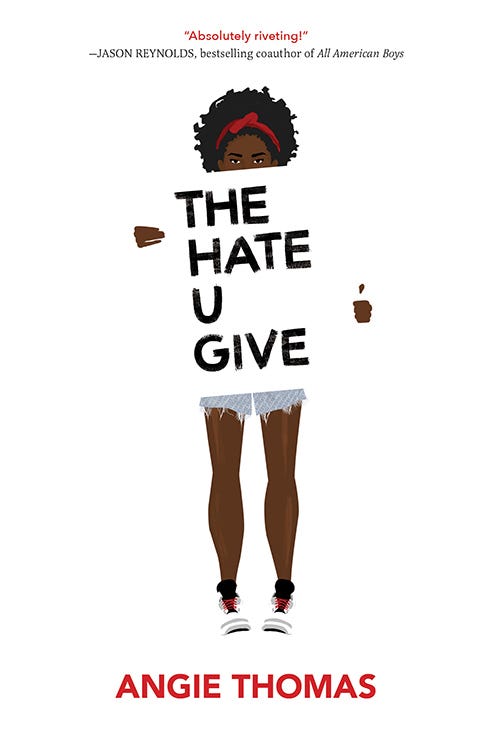
The Hate U Give
...bullets go where they wanna go.

This was another book on my Blockbuster list that I had no opinion of beforehand. I’m not typically a YA reader, so it wasn’t on my radar at all when it soared to book stardom. But I can 100% see why it did. I read it in one sitting and enjoyed the hell out of it. Angie Thomas’s writing is was strong, fearless, and so realistic I often felt I was in the room with the characters. The interpersonal dynamics in her story were fluid and complex—exactly how I love my characters. They’ll stick in my head for a long time, guaranteed.
But something was poking around in my gray matter for most of the book, just under the surface of my consciousness. There’s a specific scene, near the end of the novel that exemplifies exactly what I was pondering.
The kids are riding through the potential riots, trying to get to some semblance of safety. Starr, DeVante, and Seven have been asking Chris about “white stuff” while they drive and comparing his answers to a virtual checklist of quote/unquote blackness. Important teenage things like stereotypical food preferences and music, nothing too heavy.
But when Chris asks if he can do the same about “Black stuff”—the entire scene stops dead for a second. You can hear the record scratch. The conversation car veers off the road, and there are stares all around. In fact, that’s exactly how it’s described by the author.
The undercurrent of “How DARE he?!” is so visceral I could taste it. But why?
Why is the dialogue only allowed to go in one direction in a situation like this? How else would a white guy from the suburbs with limited contact understand an individual community’s culture? If he’s not allowed to ask questions, where’s he going to get his answers?
The likely, sad answer: He’d get them from people with biased and harmful agendas. Talking heads (not the band) and news media—exactly what happened in the novel with the murder trial.
But, thankfully they do answer him and gently point out that “normal” is relative. I could have cheered. Finally, some sincere open dialogue!
After that scene, I realized where the brain tickle had come from.
I feel similar about all the questions I have about the cultures and communities I don’t “belong” to. A little embarrassed, but thinking it’s only fair that I get to ask too. As an author, how am I supposed to write different races/genders if I get shot down when asking questions that aren’t comfortable, maybe aren’t “easy” to answer, and don’t feed someone’s agenda?
When I do ask, I often get one of two answers: “you wouldn’t even understand because you weren’t born/raised XYZ” or my favorite combo plate, “you simply asking offends me because you’re CIS, Caucasian, and/or heterosexual.”
The “How Dare You” conversation stopper all over again.
The latter, I suspect, is just an easy way of blowing me off because close examining of the world that surrounds your own life is fucking uncomfortable. You’re faced with contradictions, things you’ve ignored in your own culture(s), and the rightness/wrongness of all of it. Doesn’t matter what color or what category you do or don’t fit into. Finding out what you believed in all along was a lie pushed forward by your ancestors sucks.
You know what else is uncomfortable? Not knowing and being aware you don’t know. I don’t want to go through my life an ignorant woman, sucking on social media’s biased teat for all my information. I want to go to the people I care about, the people I TRUST, and ask the hard questions. And get some answers, even if it’s an “I don’t know.”…anything is better than being blown off simply because we don’t share the same culture(s).
So I’m going to ask some questions here (within the scope of The Hate U Give) and maybe get an answer or two, and probably some flack, but I’m not going to be scared. Only curious and hopeful someone will be kind enough to help me learn.
(And yeah, I get the irony of asking these on social media after my above rant).
1. One Fifteen’s given name isn’t used, even after Starr learns it, which I found odd at first. But then I realized it’s a way of dehumanizing him. What he did was wrong and atrocious—I honestly don’t have the words to describe how I felt. A hairbrush isn’t a handgun!—there’s no argument there.
Yet, by choosing to not use his name, isn’t it just perpetuating the dehumanization this novel is exampling/protesting against? Would the emotional impact of the novel be as great if the perpetrator and the victim were the same race?
2. How can a close, loving family be terrified of riots destroying their neighborhood/livelihood, yet be proud of their daughter for escalating it? I’ve never lived in an area where riots have been triggered, so I may just be missing context within the novel.
3. As someone in a mixed race marriage, this one is closest to home for me—does it matter which of the partners is Black and which is white? Starr brings home Chris, but would the cultural reaction be different if Seven brought home a white girl instead? I’m thinking about Mav and Iesha’s reactions to Starr bringing Chris into their respective homes, specifically.
Thank you for mentioning "115" (I think his name started with a d?), it struck me as super odd that Starr never starts referring to him by his name, especially when she reflects on how Kahlil is unfairly dehumanized by being referred to as just a drug dealer. Furthermore, after the shooting, 115 hardly appears in the book at all, making it difficult to justify Starr et all's assessments of his character. It should be such an easy loophole for Thomas to button up, but she leaves herself wide open, frustratingly weakening the moral case of her novel.
Sucking on social media's biased teat made me LOL. I think you are asking important questions, but they're more effective in an in-person realm. So many things online are mis-communicated because tone is missing, or most people don't know how to convey tone, or most people don't have a developed sense of humor or understand sarcasm or irony. So many fights erupt online because of these reasons. I do think it would be interesting to read how Chris' parents meet Starr. There are so many layers to this work, and ways of understanding it. Ultimately, I'm glad it's out there as it provokes a discussion. It's astounding that it's on the Banned Books List as Jill pointed out.